
Blog



“Youth engagement and motivation” consistently emerge as top priorities for youth-serving practitioners across our network. When youth are authentically engaged, it’s as obvious as seeing their eyes light up, smiles so big that they can't hide them, so focused and in the flow that it feels like time flies. There is also significant research to support this—engaged and motivated youth are more likely to thrive academically and socially.
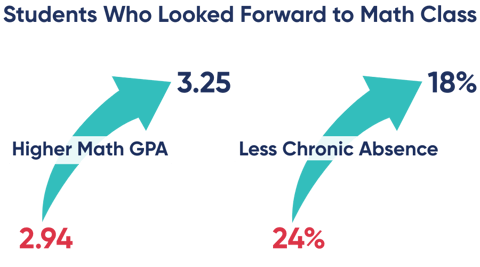
At Search Institute, we believe in strengthening youth engagement and motivation from a youth-centered and asset-based approach. We're sharing findings from a recent study: Adapted Measure of Math Engagement (AM-ME). Through the study, we surveyed more than 2,000 racially/ethnically diverse middle and high school students and found that students who looked forward to math class had a .31 higher math GPA and were 6% less likely to be chronically absent.
We're highlighting key Developmental Assets that practitioners and school/program leaders can cultivate to strengthen youth engagement and motivation. Developmental Assets are the positive supports and strengths that young people need to succeed in families, schools, neighborhoods, and communities. Internal Assets provide a map of young people’s self-perceptions, skills, and values, while external assets reflect resources, relationships, opportunities; together, they support positive development and thriving pathways.
Internal Assets: Activate What Youth Already Have Within Them to be Engaged and Motivated
Engagement and motivation go a long way when they are intrinsic– when they come from within youths themselves, rather than from external rewards or punishments. In many cases, intrinsic engagement and motivation are closely related to positive identity, a core internal asset in the Developmental Assets framework.
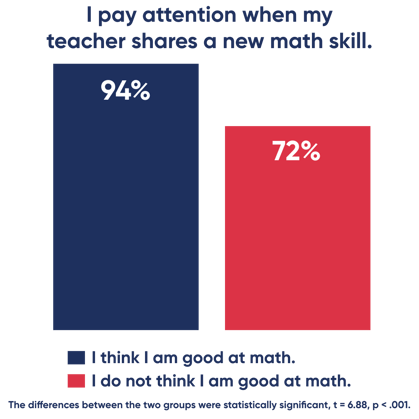
In the AM-ME survey with more than 2,000 racially/ethnically diverse middle and high school students, for example, we found that students who think they are good at math were more than 20% more likely to pay attention when new math skills were being taught, compared to students who did not think they are good at math.
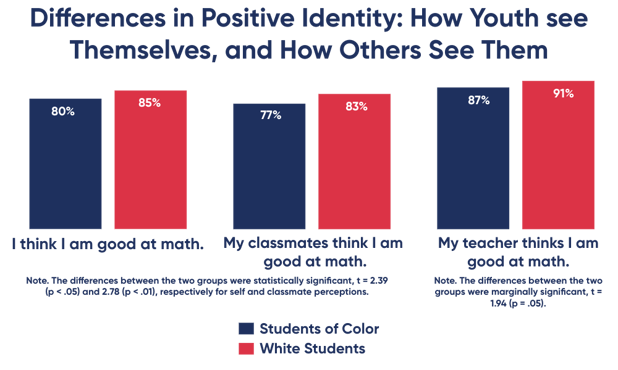
As positive identity plays a critical role in engagement and motivation, practitioners and school/program leaders should be attuned to factors that shape our identities, which include how others see us and how we see ourselves. In the AM-ME survey, for example, we found that smaller percentages of students of color thought they were good at math compared to their white peers. Similarly, fewer students of color said their classmates and teachers perceived them as being good at math.
 So, how do we cultivate youth’s positive identity in service of strengthening their engagement and motivation? One way is through affirming who they are and what’s important to the future they want for themselves. In the study, youth acknowledged that they find math much more engaging when they could see how it will be used for a job they want or an educational pathway that they aspire to.
“I'm going to be in my senior year and we don't need to take another course of math, but I chose to do it because it requires it in what I want to pursue. I want to do nursing and it requires, um, four years of math.”
Jess (Female, Hispanic student in 11th grade)
External Assets: Mobilize the Supports that Youth Have in Their Web of Relationships and Resources
In addition to cultivating internal assets, practitioners and school/program leaders can also leverage external assets to strengthen youth’s engagement and motivation. At Search Institute, we take a holistic approach to external assets– looking at the web of supportive relationships that youth are embedded in (i.e., their social capital), rather than focusing on a single relationship alone.
In the math engagement project, for example, it is clear that teachers played a critical role in shaping youth’s engagement motivation. Specifically, youth reported stronger engagement and motivation when their teachers built developmental relationships with them, used interactive teaching styles, and let them decide how they want to learn.
J: "she pushes us to do more things. Not necessarily pushes us, but she helps us understand math really good."
R: "She's stern, but, like, when you get on her good side, then she's fun and she explains math really well and she gives us time, but she also tells us to do our work. Instead of just leave it alone, like, she'll push us to do it."
A: "My teacher she's nice, she helps us a lot whenever someone needs something. She also lets us just talk and help each other out also."
K: "My teacher, she's very patient, and she's funny, and she's very nice. Like kinda what R said, she encourages us to do our work.”Jordan (Male, African American student in 8th grade)
Riah (Female, Black student in 6th grade)
Alex (Male, Mexican American student in 7th grade)
Keke (Female, Black student in 7th grade)
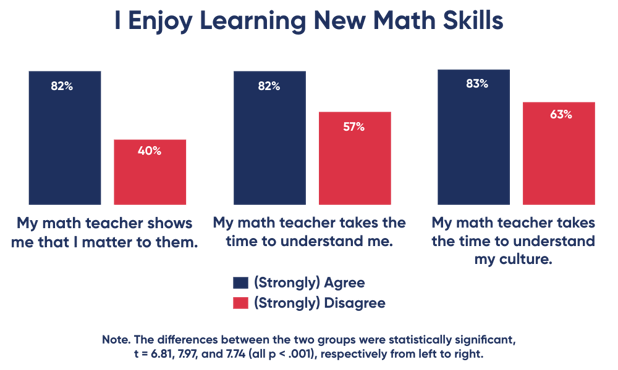
Youth also talked about being much more engaged and motivated when their teacher took the time to get to know them at a personal level, including taking the time to understand their culture. For example, students who said their math math teacher cared and understood them were more than twice as likely to enjoy learning new math skills.
 The story doesn’t end with teachers, though. Equally important, youth talked about finding motivation from leaning on people in their communities, for example parents, siblings, and cousins.
“I guess, growing up, it would be my sister because, well, her favorite subject was math. And she's the only one in the family who's graduated from college and has a career in math. And she said what really helped her was my other sister would, like, buy her math books from, like, Sam's Club. And then she would do the same thing with me. And, I don't know, I really hated it, to be honest. But now that I've grown up, I'm like, to be honest, it was really helpful.”
Isabel (Female, Mexican/Hispanic student in 9th grade)
Peer relationships are another key external asset that can be leveraged to strengthen youth’s engagement and motivation. Taking an asset-approach means educators do not see peers as a potential source of distraction; rather, educators leverage peers as a source of collaborative learning, healthy competition, and mutual encouragement.
“The epitome of an engagement, especially if we're working with manipulatives, would be all students, right, they're leaning in. If they're in a group, that means then we've got our four desks together and so their bodies are leaning in. Sometimes they're half even on the desk and they're all working together. Or sometimes it can show up as they're having a heated debate of who's right, and they're just trying to figure out like, "Well, I got this. No, I got that," and they're trying to reason who is right”.
Jasmine (Female, White, 6th Grade Math Teacher)
Resources to Strengthen Math Engagement and Motivation
Developmental Assets provide a research-driven, actionable framework for understanding and strengthening youth engagement and motivation. Here we focused on positive identity, an internal asset, and on youth’s supportive relationships, an external asset. Each one plays a role in supporting student motivation and engagement in math and each is essential for supporting positive development more broadly. For more on an asset-based approach to youth engagement and motivation, we encourage you to check out the following resources and relevant readings:
-
The value beliefs activity in the DR+Math toolkit encourages educators to reflect on how students’ value beliefs, including identity and interest, shape their engagement and motivation.